

Switching from paper to digital wedding invitations can save $300–$800 and shave hours off your coordination workload. That's not a minor perk. For couples juggling vendor calls, seating charts, and guest lists, those savings in time and money matter enormously. But the real shift isn't just financial. Digital invites are fundamentally changing how weddings are organized, how guests respond, and how planners stay in control. This article walks you through the concrete advantages, the honest trade-offs, and the best practices that make digital invitations work beautifully for everyone involved.
Table of Contents
- Why digital invites are changing event coordination
- Comparing costs and eco-impact: Digital vs. paper invites
- Personalization and inclusivity: Making digital invites work for everyone
- Best practices for streamlined guest management
- The overlooked benefits (and pitfalls) of digital invites
- Ready to simplify your event with digital invites?
- Frequently asked questions
Key Takeaways
| Point | Details |
|---|---|
| Instant RSVP tracking | Digital invites give you real-time guest responses and coordination power. |
| Significant cost savings | Switching saves hundreds compared to paper invitations and printing. |
| Eco-friendly choice | Digital invitations reduce waste and environmental impact for every event. |
| Hybrid solutions recommended | Mix digital with paper for tech-challenged guests to maximize inclusivity. |
Why digital invites are changing event coordination
The old way of managing wedding RSVPs looked like this: send paper invites, wait weeks, chase down non-responders by phone, manually update a spreadsheet, and hope the final count was close enough for the caterer. Digital invites break that cycle entirely.
Real-time RSVP tracking and centralized guest list management mean you always know exactly where you stand. No more guessing. When a guest confirms, declines, or updates their dietary preference, your dashboard reflects it instantly. That live data feeds directly into seating arrangements and catering counts, reducing the risk of costly errors.
Here's a quick look at what modern digital invite platforms actually deliver:
| Feature | Benefit for coordinators |
|---|---|
| Real-time RSVP tracking | Instant guest count updates |
| Automatic reminders | Higher response rates, less chasing |
| Centralized guest dashboard | One place for all guest data |
| QR codes and personalized links | Frictionless guest experience |
| Dietary and preference collection | Seamless vendor communication |
Automatic reminders are a game changer. Instead of manually following up with every non-responder, the platform sends timed nudges on your behalf. Response rates climb, and you spend that time on things that actually need your attention.
Personalized invite links also add a layer of precision. Each guest receives a unique URL tied to their record, so you know exactly who opened the invite, who clicked through, and who still needs a nudge. That kind of visibility is impossible with paper.
- Track dietary restrictions and meal choices in real time
- Filter guests by status: confirmed, declined, or pending
- Sync guest data with seating tools and vendor sheets
- Send targeted follow-ups to specific guest segments
Pro Tip: Choose a platform that offers a private organizer dashboard where you can monitor responses, flag dietary needs, and export your guest list at any time. A good seamless digital invite design paired with strong backend tools is the combination that makes coordination feel effortless.
For a deeper look at managing responses efficiently, the RSVP tracking guide covers the full workflow from first send to final count.
Comparing costs and eco-impact: Digital vs. paper invites
Beyond organization, cost and environmental concerns weigh heavy on modern planners. The numbers here are striking.
Paper invitations for 100 guests typically run between $370 and $870 once you factor in design, printing, envelopes, postage, and any last-minute reprints for address changes. Digital invitations for the same guest count can range from free to around $200, depending on the platform and features you choose. That's a cost savings of $300–$800+ that can go straight toward your flowers, food, or honeymoon.
| Factor | Paper invitations | Digital invitations |
|---|---|---|
| Cost for 100 guests | $370–$870 | $0–$200 |
| Delivery time | 5–10 business days | Instant |
| Design changes | Costly reprint required | Free, instant update |
| Environmental impact | High (paper, ink, postage) | Minimal |
| Guest corrections | New print run needed | Edit and resend in minutes |
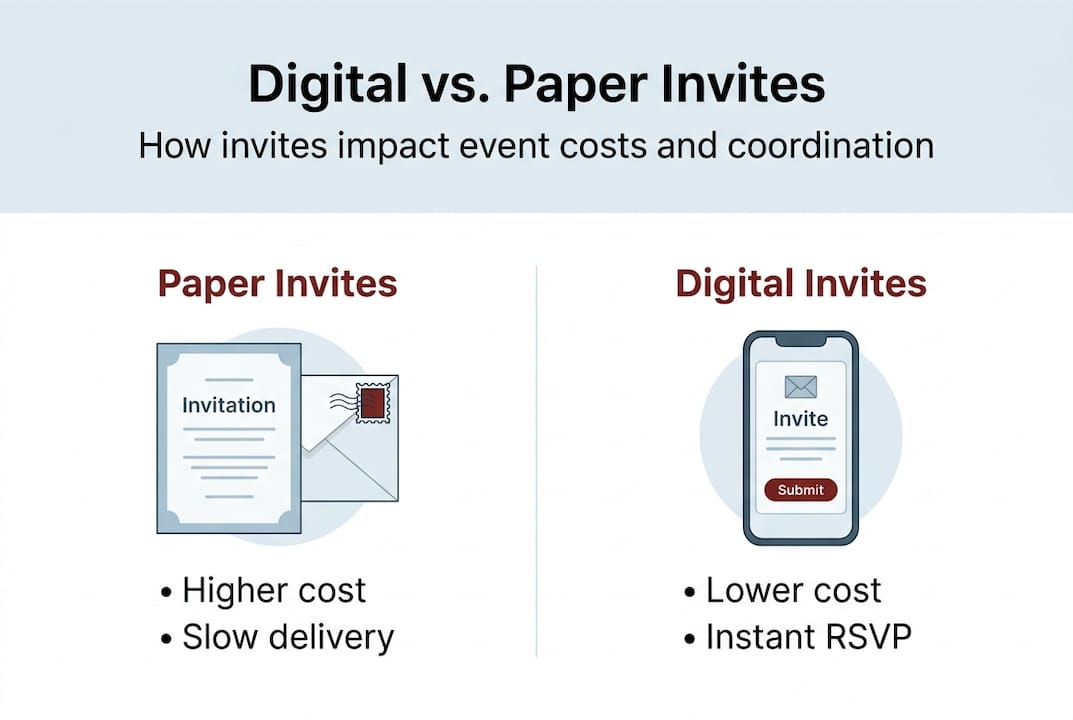
The environmental case is just as compelling. Traditional paper invites consume trees, ink, and fuel for shipping, and most end up in the recycling bin within days of the wedding. Digital invites eliminate printing and postage entirely, making them a genuinely eco-friendly choice for couples who care about their footprint.
There's also a practical speed advantage. Need to update the venue address after a last-minute change? With paper, that means a reprint and a re-send. With digital, you edit once and every guest sees the update immediately. That kind of flexibility is invaluable when real-world planning rarely goes perfectly.
- No postage costs, ever
- Instant global delivery, regardless of guest location
- Easy bulk corrections without reprinting
- Lower carbon footprint per event
For couples looking to save on invitation costs without sacrificing style, digital is no longer the budget option. It's the smart option.
Personalization and inclusivity: Making digital invites work for everyone
While digital invites offer savings and efficiency, personalization and guest inclusivity matter just as much. One common concern is that going digital means sacrificing elegance or warmth. That's simply not true anymore.
Today's platforms let you build invitations with custom color palettes, embedded video messages, photo galleries, background music, and interactive maps. A bespoke digital invite can feel every bit as personal and polished as a printed card, and often more so because it can actually move, play music, and respond to the guest.

But what about guests who aren't comfortable with technology? This is where a hybrid approach makes sense. Hybrid approaches are widely recommended: send digital invites to most guests, and reserve printed cards for elderly relatives or VIPs who prefer something tangible.
Here's a simple process for blending both formats:
- Identify guests who may struggle with digital formats (typically older relatives or those without reliable internet access).
- Design a matching paper invite for that smaller group, keeping the visual style consistent with your digital version.
- Add a QR code to the paper invite that links to your digital RSVP page, giving tech-comfortable recipients an easy option.
- Use SMS or WhatsApp to send a backup link to guests who have email but may miss it in their spam folder.
- Monitor your dashboard for any guests who haven't responded and follow up personally.
"Hybrid invitations aren't just a compromise. They ensure every guest feels valued and included, regardless of their comfort with technology."
Pro Tip: Spam filters can block emails from unfamiliar senders. Always send a WhatsApp or SMS message alongside your email invite to make sure it lands. This small step dramatically improves open rates and keeps your privacy with digital invites intact since you're not relying on a single channel.
Best practices for streamlined guest management
Personalization and inclusivity in invites set the stage, but practical guest management is where digital tools truly shine. A well-organized guest list isn't just a spreadsheet. It's a living document that evolves as your event approaches.
Central dashboards give you and your planning team a single source of truth. Everyone sees the same data, so there's no confusion about who confirmed or what meal they requested. Digital invites sync seamlessly with seating tools and catering teams, which means fewer errors and fewer frantic calls the week before the wedding.
Here are the top features to look for when evaluating a guest management platform:
- Guest tagging: Label guests by group (family, work colleagues, wedding party) for easy filtering
- Status filters: View confirmed, declined, and pending guests at a glance
- Custom fields: Collect meal preferences, song requests, or accessibility needs
- Automated reminders: Schedule follow-ups for non-responders without manual effort
- Export tools: Download your guest list as a spreadsheet for vendors and venue staff
Regular communication updates matter too. Don't just send the initial invite and go quiet. Use your platform to share venue updates, schedule changes, or day-of logistics directly from the same dashboard. Guests appreciate consistency, and keeping everything in one place reduces confusion.
For the full step-by-step process, the digital RSVP workflow guide walks through every stage from design to final guest count.
Pro Tip: Assign specific team members to manage different guest groups. One person handles the family list, another manages the work colleagues, and a third covers the wedding party. This division of responsibility keeps your digital RSVP platform organized and prevents duplicate follow-ups or missed guests.
The overlooked benefits (and pitfalls) of digital invites
Here's something most articles won't tell you: the platform you choose matters more than the format itself. We've seen couples invest in beautiful digital invites only to discover the platform had no customer support, a clunky RSVP interface, or unreliable email delivery. The invite looked stunning. The coordination was a mess.
Vet your platform before you commit. Test the RSVP flow as a guest. Check whether the dashboard is actually intuitive. Ask about delivery reliability and whether the service offers premium digital invitation features like real-time confirmations and guest list exports.
Timing is another overlooked pitfall. Sending digital invites too early means guests forget or lose the link. Too late and people have already made plans. The sweet spot for most weddings is 6 to 8 weeks out, with a save-the-date sent 3 to 4 months ahead.
And don't abandon paper entirely out of principle. The couples who get this right use digital for speed and scale, and paper for sentiment. A handwritten note tucked inside a physical card for your grandmother carries emotional weight that no animated invite can replicate. That's not a failure of digital. That's just knowing your audience.
Transparent communication with less tech-savvy guests isn't optional. It's what separates a smooth experience from a frustrating one.
Ready to simplify your event with digital invites?
If you're considering digital invites for your wedding or event, the right platform makes all the difference. At The Digital Yes, we've built a platform specifically for couples and wedding professionals who want beautiful, functional invitations without the coordination headaches.
Every invitation includes real-time RSVP tracking, a private organizer dashboard, guest list export tools, and full customization from colors to embedded media. There are no subscriptions, just a one-time payment for an invitation that works as hard as you do. Whether you're planning an intimate gathering or a 300-person celebration, we make it easy to start your digital invite journey today.
Frequently asked questions
How do digital invites improve wedding guest coordination?
Digital invites enable instant RSVPs, real-time updates, and centralized guest list management, so you always have an accurate count and can communicate with all guests from one dashboard.
Are digital invites really more cost-effective than paper?
Yes. You can save $300–$800+ for 100 to 200 guests by choosing digital over paper, and you avoid the cost of reprints when details change.
What happens if a guest doesn't use email or misses a digital invite?
You can send a paper invite to guests who prefer it, and use SMS/WhatsApp as a backup delivery channel to make sure every guest receives their invitation regardless of email reliability.
Can digital invites be customized to match my wedding theme?
Absolutely. Modern platforms offer full customization including color palettes, typography, embedded video, photo galleries, background music, and interactive maps to match any wedding aesthetic.