
Most couples who choose digital wedding invitations feel good about skipping the paper. And they should. But the full environmental story is a little more nuanced than simply swapping cardstock for a link. Digital invitations significantly reduce paper waste, tree usage, water consumption, chemical use, and transportation emissions compared to paper. Still, digital is not zero-impact, and knowing exactly where the footprint hides helps you make the greenest possible choice for your celebration. This article breaks down the real numbers, the hidden costs, and the practical steps that actually move the needle.
Table of Contents
- Why consider the environmental impact of wedding invitations?
- How digital invitations and paper invitations compare environmentally
- Hidden footprint: The true cost of going digital
- How to minimize the digital footprint of your eco-friendly invites
- Eco-friendly wedding invitations made simple with The Digital Yes
- Frequently asked questions
Key Takeaways
| Point | Details |
|---|---|
| Digital wins on footprint | Digital invitations dramatically reduce paper, energy, and carbon compared to traditional wedding invites. |
| Hidden digital costs | Device manufacturing and server energy still create a small footprint, but much less than paper overall. |
| Simple is greener | Choosing basic designs and green hosting keeps your digital invites’ impact as low as possible. |
| Combine best practices | Using WiFi and sharing web-based RSVPs further reduces the environmental impact of any celebration. |
Why consider the environmental impact of wedding invitations?
Wedding invitations feel like a small detail in the grand scheme of planning a celebration. But when you multiply one invite by 150 guests, add envelopes, inner envelopes, RSVP cards, and postage, the numbers grow fast. Wedding footprint calculators include paper invitations as a measurable factor in a couple's total CO2 output, right alongside catering and travel.
Here is what goes into a single traditional paper invitation set:
- Paper production: Trees, water, and bleaching chemicals
- Printing: Energy, ink (often petroleum-based), and press waste
- Packaging: Envelopes, tissue paper, wax seals, and plastic wrapping
- Delivery: Fuel for postal trucks and sorting facilities
- Disposal: Most paper invites end up in landfill within weeks
Each of those steps releases carbon dioxide or consumes finite resources. Digital invitations significantly reduce all of these key environmental impacts compared to paper alternatives. The lifecycle concept is simple: every invitation, whether printed or digital, has an environmental story from creation to delivery to disposal. Understanding that story is the first step toward making a smarter choice.
"Every product has a lifecycle. The question is not whether there is an impact, but how large it is and where it falls." This framing applies perfectly to wedding invitations.
You can also think about the privacy and security of digital invitations as an added benefit beyond sustainability, since no physical address lists are printed or mailed.
How digital invitations and paper invitations compare environmentally
Let's put real numbers on the table. The comparison below is based on a guest list of 100 people, using lifecycle analysis data for both formats.
| Factor | Paper invitations (100 guests) | Digital invitations (100 guests) |
|---|---|---|
| Paper and raw materials | High (trees, pulp, water) | None |
| Printing energy | Significant | None |
| Ink and chemicals | Petroleum-based inks | None |
| Packaging and postage | Envelopes, stamps, fuel | None |
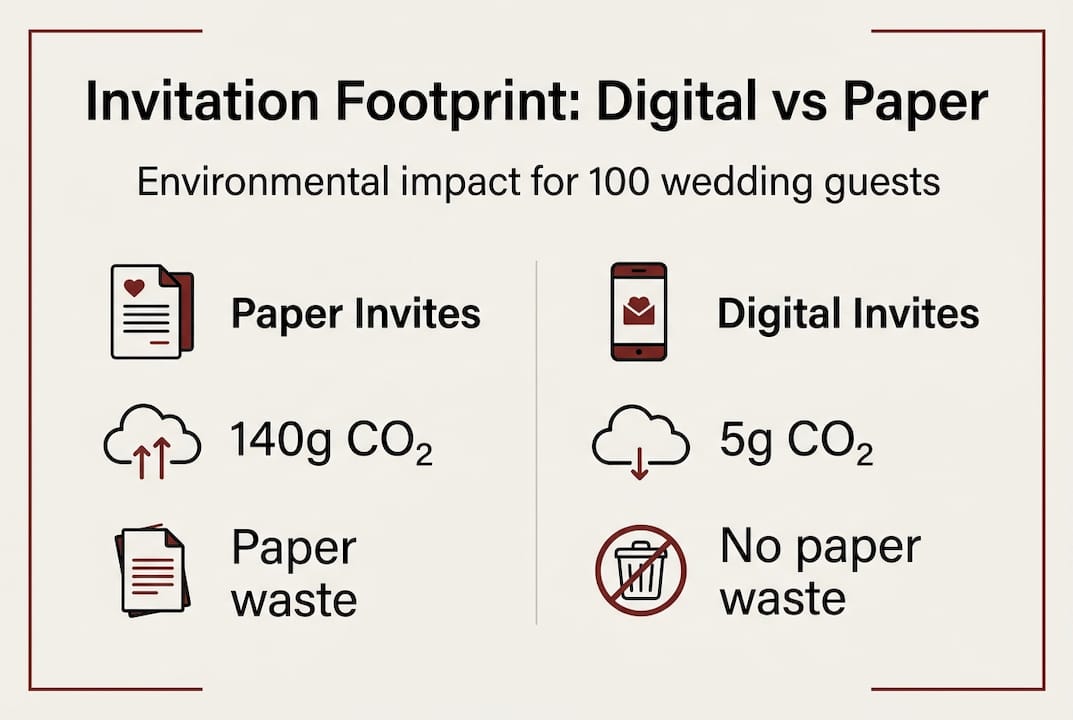
| CO2 per invitation | ~140g CO2e | ~50g CO2e |
| Waste after event | Mostly landfill | Minimal |
| Water use | High | Negligible |
The CO2 comparison is striking: a traditional greeting card or invitation produces around 140g of CO2 equivalent, while a digital version produces around 50g. For 100 guests, that gap adds up to roughly 9kg of CO2 avoided, just from switching formats.

Lifecycle analysis looks at every stage of a product's life, from raw material extraction through manufacturing, use, and disposal. When you apply this lens, digital invitations use a fraction of the energy, water, and raw materials per invite compared to paper. The digital footprint comes mainly from the devices guests use to view the invite and the servers that host it, both of which are shared across billions of other uses.
When designing digital invitations sustainably, you can further reduce impact by keeping file sizes lean and avoiding heavy video embeds. And if you want to explore what a fully realized digital invite looks like, premium digital invitation features like RSVP tracking and guest dashboards replace multiple paper touchpoints at once.
Pro Tip: If you absolutely need a printed element, choose recycled or FSC-certified paper, soy-based inks, and a local printer to cut transportation emissions significantly.
Hidden footprint: The true cost of going digital
Digital invitations win on almost every environmental metric. But calling them zero-impact would be misleading. The hidden footprint is real, even if it is small.
Here is what actually contributes to the carbon footprint of a digital invitation:
- Device manufacturing: The smartphone or laptop your guest uses to open the invite required significant energy and materials to produce.
- Data center energy: Servers that host and deliver your invitation use electricity, though this is spread across millions of simultaneous operations.
- Network transmission: Data traveling through routers and cables consumes a small amount of energy per message.
- Guest device charging: Viewing content on a device draws power, though the amount per invitation view is tiny.
- Design file size: Larger files with heavy graphics or video require more server storage and transmission energy.
The most surprising fact here is that 92% of an email's carbon footprint comes from device manufacturing, not from sending or hosting the message. That means the act of sending a digital invite is almost negligible in isolation. The environmental impact of digital systems is real but minimal per invitation when spread across shared infrastructure.
The good news: data centers are getting greener every year. Major cloud providers are investing heavily in renewable energy, which means the digital footprint of your invitation will likely be even smaller by the time your guests RSVP.
Server efficiency improvements and the global shift toward renewable-powered data centers mean digital communications are on a downward emissions trajectory. Paper, by contrast, still requires cutting trees and running printing presses.
If you want to go further, explore customization and digital invitation options that prioritize lightweight design, or browse theme inspiration for digital invites that look stunning without heavy file loads.
Pro Tip: Keep your digital invitation design clean and minimal. Fewer large images and no autoplay video means smaller file sizes, faster loading, and a lower energy draw per view.
How to minimize the digital footprint of your eco-friendly invites
Choosing digital is already the right move. But a few extra steps can make your invitation genuinely as green as possible.
- Choose a green-hosted platform: Look for invitation services that use renewable-energy-powered servers or carbon-offset hosting. This directly reduces the emissions tied to storing and delivering your invite.
- Keep the design simple: Clean layouts with optimized images load faster and use less energy at every point in the delivery chain. Simple designs and green-hosted platforms are the two most effective levers for reducing digital invite pollution.
- Consolidate your communications: Use your digital invitation platform for RSVPs, guest messaging, and event updates. Fewer separate emails and messages mean a smaller cumulative footprint.
- Skip the print-and-mail follow-up: Resist the urge to send a paper reminder or save-the-date after your digital invite. Each additional physical touchpoint adds back the emissions you worked to avoid.
- Educate your guests: A short note in your invitation asking guests to save the link rather than printing it out can prevent unnecessary paper use on their end.
Combining your digital invite with web-based RSVPs and a guest messaging system means you replace not just the invitation but the entire paper-based communication chain. That is where the real savings stack up. You can save costs and reduce impact at the same time, since digital platforms eliminate printing, postage, and envelope costs entirely.
If you are new to the process, a step-by-step digital design guide can walk you through creating an invitation that is both beautiful and environmentally responsible from the first click.
Pro Tip: Ask your guests to open the invitation on WiFi rather than mobile data. WiFi access uses less energy per data transfer than cellular networks, which lowers the footprint of every single view.
Eco-friendly wedding invitations made simple with The Digital Yes
Everything covered in this article points in one direction: digital invitations done thoughtfully are the greenest choice available for modern weddings. The platform needs to match the intention.
The Digital Yes builds digital wedding invitations that align with every sustainability principle discussed here. Designs are clean and optimized for fast loading, which directly reduces the energy cost of each guest view. The platform handles RSVPs, guest management, real-time updates, and multilingual support, replacing the entire paper communication chain with a single, elegant digital experience. There are no subscriptions, no recurring fees, and no printing costs. For couples and planners who want to celebrate beautifully without the environmental weight of traditional stationery, it is a natural fit. You can also explore privacy-first invitation options that keep your guest data secure from the moment you send.
Frequently asked questions
Are digital invitations completely carbon neutral?
No. Digital invitations are far greener than paper, but they carry a small footprint from device manufacturing and server energy. Choosing a green-hosted platform and minimal design brings that number as low as possible.
Can I make paper invitations eco-friendly?
Yes. Recycled or FSC-certified paper, soy-based inks, and a local printer all reduce the impact of paper invites. That said, digital still carries a lighter footprint for most wedding guest lists.
What's the one thing that makes digital invites greenest?
Simple design and green hosting are the two biggest levers. A clean, lightweight invitation on a renewable-energy server has the smallest possible digital footprint.
Does the way guests access the invite matter?
Yes. WiFi access uses less energy per data transfer than mobile networks, so encouraging guests to open the invite on WiFi or a laptop genuinely reduces the invitation's total energy use.