

Many couples assume that running their wedding invitation text through an automated translator is enough to communicate with multilingual guests. This oversimplification misses the cultural nuances, technical requirements, and guest experience factors that make truly effective multi-language invitations work. Digital wedding invitations offer unprecedented opportunities to connect with diverse guest lists in their native languages, but success requires understanding both the technology and the human elements. This guide walks you through the essential components of creating customizable multi-language digital wedding invitations that respect cultural backgrounds while ensuring clear communication with every guest.
Table of Contents
- Why Multi-Language Support Matters For Wedding Invitations
- Technical Essentials: How Multi-Language Support Works Behind The Scenes
- Common Challenges And Expert Tips For Flawless Multi-Language Invitations
- How To Implement Multi-Language Support In Your Wedding Invitations
- Create Your Multi-Language Digital Wedding Invitations Today
- FAQ
Key takeaways
| Point | Details |
|---|---|
| Guest experience improves | Proper multilingual support reduces misunderstandings and increases RSVP rates significantly |
| Build early, save money | Implementing multi-language capabilities from the start costs far less than retrofitting later |
| Culture beats translation | Adapting content culturally creates deeper engagement than word-for-word translation alone |
| Technical foundation matters | Unicode support and dynamic rendering ensure invitations display correctly across all languages |
| Human review essential | Professional translators catch errors that automated systems miss consistently |
Why multi-language support matters for wedding invitations
Wedding invitations represent your first formal communication with guests about one of life's most important celebrations. When guests receive information in their native language, engagement transforms dramatically. Research shows that 72% of consumers prefer buying in their native language, and this preference extends powerfully to wedding communications where emotional connection and clear understanding matter most.
Multi-language invitations demonstrate profound respect for your guests' cultural backgrounds and traditions. A grandmother who speaks primarily Mandarin, cousins who communicate in Spanish, or colleagues who prefer French all feel genuinely welcomed when they can read event details in their most comfortable language. This inclusive approach reduces the likelihood of misunderstandings about ceremony times, dress codes, venue locations, or RSVP deadlines.
The practical benefits extend beyond sentiment. Guests who understand invitation details clearly are more likely to respond promptly, arrive on time, and follow event guidelines. Confusion about whether children are invited, what attire is appropriate, or how to navigate to the venue creates unnecessary stress for both hosts and attendees. When you invest in proper multilingual support, you eliminate these friction points before they occur.
Modern bespoke digital invitations make multi-language implementation more accessible than ever before. Unlike printed invitations where each language version requires separate design and printing runs, digital platforms allow guests to toggle between languages seamlessly. This flexibility means you can accommodate diverse linguistic needs without multiplying costs or complicating logistics.
Consider these compelling reasons to prioritize multi-language support:
- Enhanced guest comfort and confidence in understanding event details
- Reduced phone calls and messages asking for clarification
- Higher RSVP completion rates when guests can respond in their preferred language
- Stronger emotional connection through culturally appropriate messaging
- Professional impression that reflects attention to guest needs
"Language is the road map of a culture. It tells you where its people come from and where they are going." This insight applies directly to wedding invitations, where language choices signal how deeply you value each guest's presence and background.
Technical essentials: how multi-language support works behind the scenes
The foundation of effective multi-language digital invitations rests on robust technical architecture. Unicode UTF-8 encoding serves as the essential standard, ensuring that characters display correctly across all languages, including complex scripts like Arabic, Chinese, Thai, and Hebrew. Without proper encoding, your carefully crafted invitation text can appear as garbled symbols or question marks to recipients.

Translation APIs provide the engine for converting content between languages. Services like Google Translate, DeepL, and Microsoft Translator offer automated translation that handles basic conversion quickly. However, these tools require human oversight to catch contextual errors, cultural inappropriateness, or awkward phrasing that machines miss. The most effective approach combines API efficiency with professional translator review for final polish.
Dynamic content rendering determines which language version displays to each guest. Sophisticated platforms detect browser language preferences, allow manual language selection, or remember guest choices across sessions. This technology ensures that when your aunt in Tokyo opens the invitation, she sees Japanese automatically, while your college friend in Mexico City views Spanish without any extra steps.
Localization extends beyond simple word translation to encompass cultural adaptation:
- Date formats vary globally (MM/DD/YYYY in the US versus DD/MM/YYYY in Europe)
- Time notation differs (12-hour versus 24-hour formats)
- Currency symbols and number formatting change by region
- Address formats follow country-specific conventions
- Honorifics and formal titles carry different weight across cultures
Pro Tip: Test your invitation's date and time displays across multiple language settings before sending. A ceremony scheduled for 3:00 PM on 06/07/2026 could be interpreted as June 7th or July 6th depending on regional conventions, creating catastrophic confusion.
Here's how different technical components interact to deliver seamless multi-language experiences:
| Component | Function | Why it matters |
|---|---|---|
| UTF-8 encoding | Displays all character sets correctly | Prevents garbled text in non-Latin scripts |
| Translation memory | Stores approved translations | Ensures consistency across invitation sections |
| Language detection | Identifies guest preferences | Reduces manual selection friction |
| Fallback language | Displays default when preferred unavailable | Prevents broken experiences |
| Right-to-left support | Reverses text direction for Arabic/Hebrew | Maintains readability and professionalism |
Modern wedding RSVP tracking systems integrate multilingual capabilities directly into response forms. Guests can not only read the invitation in their language but also submit dietary preferences, song requests, and attendance confirmations using familiar terminology. This end-to-end language consistency creates a cohesive experience that traditional paper invitations cannot match.
Common challenges and expert tips for flawless multi-language invitations
Right-to-left languages like Arabic, Hebrew, Urdu, and Farsi present unique layout challenges that many platforms handle poorly. Text direction affects not just individual words but entire page layouts, navigation elements, and form fields. Proper handling of edge cases prevents embarrassing display errors where text flows incorrectly or design elements misalign. Your invitation design must accommodate bidirectional text gracefully, ensuring that mixed-language content (like English names within Arabic text) displays logically.
Retrofitting multi-language support after launching your invitation creates exponentially more work than building it from the beginning. Studies indicate that adding multi-language support after launch costs 3-5x more than initial implementation. This cost multiplier stems from redesigning layouts, restructuring databases, updating all existing content, and testing compatibility across previously finalized features.
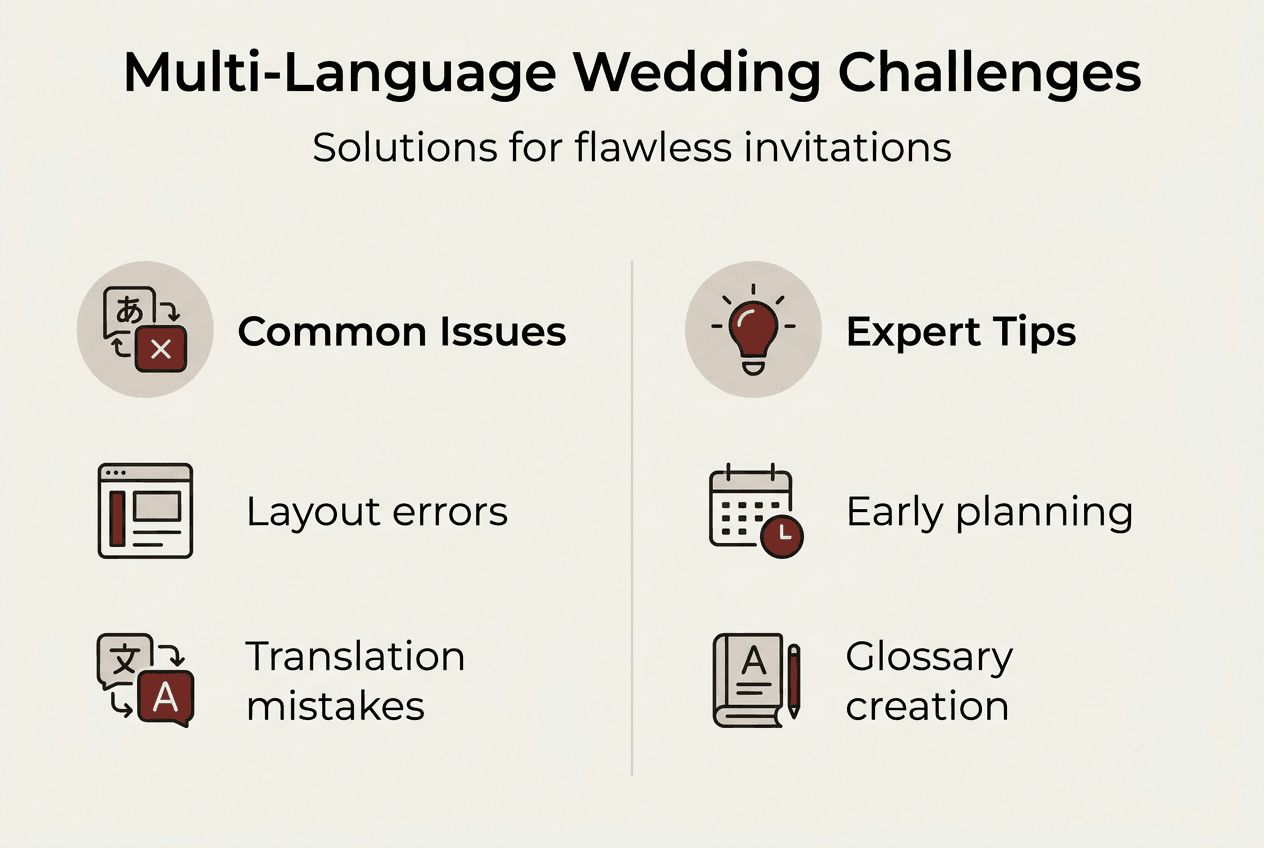
Machine translation excels at speed but fails at nuance. Automated systems struggle with idioms, cultural references, formal versus informal register, and context-dependent meanings. A phrase like "black tie optional" might translate literally in ways that confuse guests unfamiliar with Western dress code conventions. Professional human review catches these subtleties, ensuring your invitation communicates appropriately across cultural contexts.
Pro Tip: Create a glossary of wedding-specific terms with approved translations before starting. Words like "reception," "rehearsal dinner," "plus one," and "registry" often lack direct equivalents in other languages and require culturally appropriate alternatives.
Architectural decisions about text storage dramatically affect translation efficiency. Hardcoding user-facing text directly into templates makes updates painful and error-prone. Storing all text in external resource files or databases allows translators to work independently without touching code. This separation of content from presentation accelerates translation workflows and reduces the risk of introducing bugs during language updates.
Common pitfalls to avoid:
- Assuming all guests speak English as a backup language
- Neglecting to translate confirmation emails and reminder messages
- Using images with embedded text that cannot be localized
- Forgetting about customer support communications in multiple languages
- Overlooking cultural taboos in color choices, imagery, or symbolism
| Challenge | Poor approach | Better approach |
|---|---|---|
| Arabic text display | Leave layout unchanged | Implement full RTL support with mirrored navigation |
| Date formatting | Use single format globally | Detect locale and format appropriately |
| Translation quality | Rely solely on machine translation | Combine API with professional review |
| Language switching | Require page reload | Enable instant dynamic switching |
| Cultural adaptation | Direct word-for-word translation | Adapt idioms and cultural references |
"The limits of my language mean the limits of my world." When your wedding invitation respects linguistic diversity, you expand the world you share with your guests and create genuine inclusion.
Testing represents the final critical step that many couples skip. View your digital wedding invitations with RSVP in every target language on multiple devices and browsers. Check that text doesn't overflow containers, buttons remain clickable, and forms submit correctly. Recruit native speakers to review not just translation accuracy but overall user experience and cultural appropriateness.
How to implement multi-language support in your wedding invitations
Successful multi-language implementation begins during initial planning, not as an afterthought. Before selecting your invitation platform or designer, confirm that multi-language support is built in from day one rather than requiring custom development. This early decision prevents costly pivots later when you discover your chosen solution cannot accommodate your linguistic needs.
Follow these steps for smooth implementation:
- Identify all languages you need to support based on your guest list composition
- Research platforms that offer native internationalization (i18n) capabilities
- Create your invitation content in your primary language first
- Develop a translation brief explaining cultural context and tone preferences
- Engage professional translators or carefully review machine translations
- Test all language versions thoroughly across devices and browsers
- Gather feedback from native speakers before finalizing
- Set up language preference tracking for consistent guest experiences
Choosing the right platform makes everything easier. Look for solutions that provide template-based language switching, built-in translation management, and automatic locale detection. Bespoke digital invitations often include customizable language options as standard features, saving you from technical headaches.
Translation quality directly impacts guest perception. While machine translation offers a starting point, professional translators ensure your tone matches the formality level appropriate for wedding communications in each culture. Some languages distinguish between formal and informal "you" pronouns, and choosing incorrectly can seem disrespectful or overly casual.
Key considerations for translation quality:
- Hire translators familiar with wedding terminology and cultural customs
- Provide context about your wedding style (formal, casual, traditional, modern)
- Review translations with native-speaking friends or family members
- Check that honorifics and titles follow cultural norms
- Verify that RSVP instructions are actionable and clear
Thorough testing prevents embarrassing mistakes. Create test accounts or preview links for each language version. Verify that all interactive elements function properly, including RSVP forms, photo galleries, embedded maps, and music players. Pay special attention to form validation messages, error notifications, and confirmation screens, which often get overlooked during translation.
Communicate proactively with guests about language options. Include a brief note in save-the-date messages explaining that invitations will be available in multiple languages. When you send the actual invitation, make language selection obvious and frictionless. Some guests may not realize they can switch languages unless you explicitly point out this feature.
Pro Tip: Send a test invitation to yourself and a few trusted friends in each target language several weeks before your main send. This buffer allows time to fix any issues that surface without rushing under deadline pressure.
Create your multi-language digital wedding invitations today
Navigating the technical and cultural complexities of multi-language wedding invitations becomes effortless when you work with a platform designed specifically for this purpose. The Digital Yes offers customizable digital wedding invitations with built-in multi-language support, eliminating the need for custom development or technical expertise. Your guests can seamlessly toggle between languages while enjoying features like RSVP tracking, embedded maps, photo galleries, and multimedia elements.
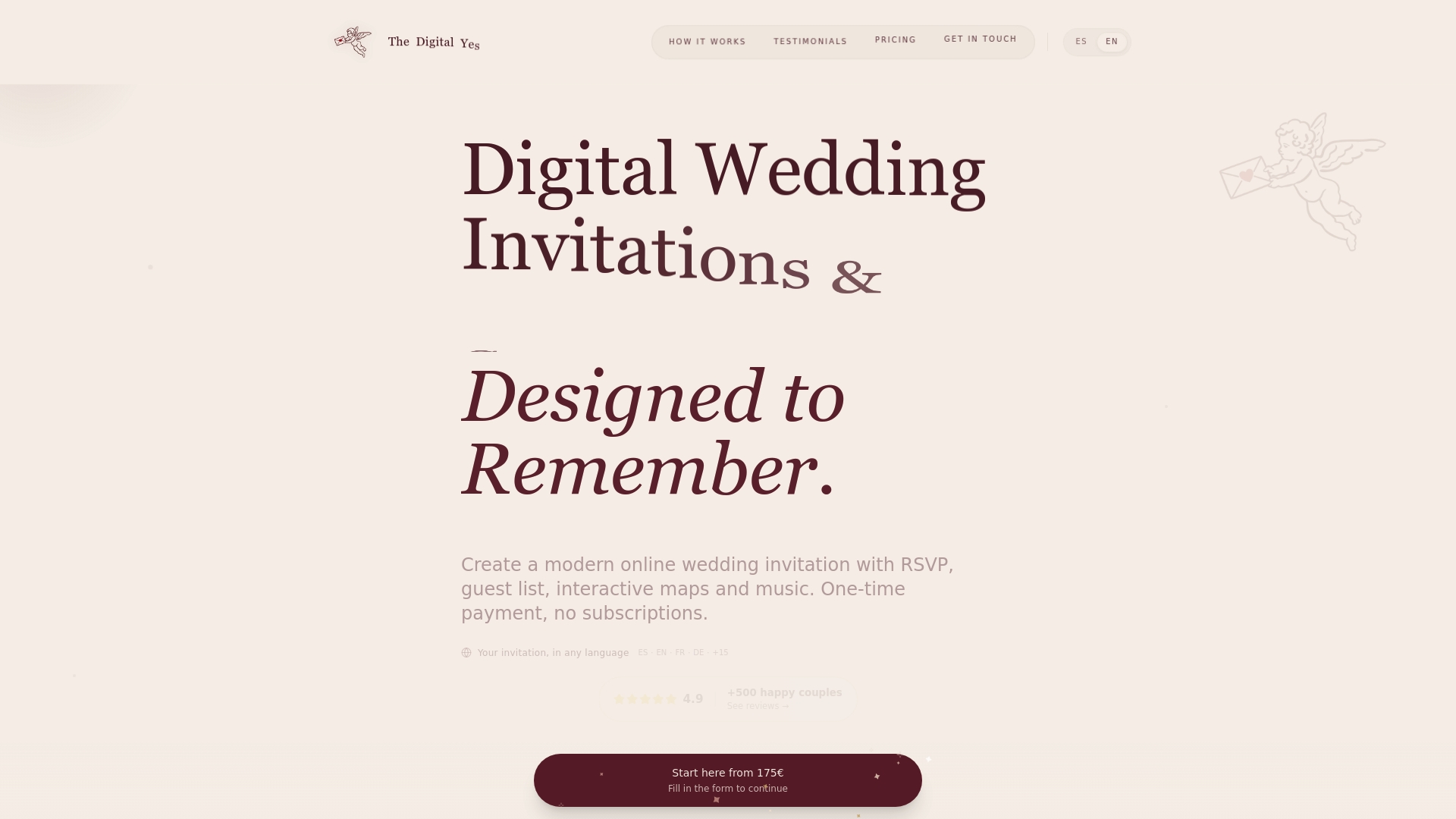
The platform's intuitive interface lets you manage all language versions from a single dashboard, ensuring consistency across translations while maintaining the flexibility to adapt content for cultural appropriateness. Real-time RSVP tracking works across all languages, giving you unified guest management regardless of which language each person prefers. Explore how digital invitations work to see the full range of customization options available, from template-based designs to fully bespoke creations. Check out transparent pricing plans with one-time payments and no recurring subscriptions, making professional multi-language invitations accessible for every budget.
FAQ
What languages can be supported in digital wedding invitations?
Most modern digital invitation platforms support all major world languages, including right-to-left scripts like Arabic and Hebrew, Asian languages like Chinese and Japanese, and European languages like Spanish, French, and German. The specific languages available depend on the platform's technical capabilities and font libraries. Unicode-compliant systems can theoretically support any written language, though practical implementation varies by provider.
How much does it cost to add multiple languages to wedding invitations?
Costs vary significantly based on whether you build multi-language support from the start or add it later. Initial implementation typically adds minimal cost when using platforms with native multi-language features. Professional translation services range from ten to thirty cents per word depending on language pair and complexity. Retrofitting multi-language support to existing invitations costs substantially more due to redesign and testing requirements.
Can guests switch languages after opening the invitation?
Yes, well-designed multi-language digital invitations allow guests to switch languages dynamically without reloading the page or requesting a new link. The platform should remember each guest's language preference across sessions, so they see their chosen language automatically on return visits. This flexibility ensures guests can share invitations with family members who speak different languages.
Do I need separate invitation links for each language?
No, modern multi-language implementations use a single invitation link that detects guest preferences or allows manual language selection. This approach simplifies distribution and tracking while providing personalized experiences. Separate links per language create management headaches and complicate RSVP tracking, so avoid platforms that require this outdated approach.
How do I ensure translations are culturally appropriate?
Engage professional translators familiar with wedding customs in your target cultures rather than relying solely on machine translation. Provide context about your wedding style, formality level, and any cultural sensitivities. Have native speakers review final translations before sending, paying special attention to idioms, dress code descriptions, and gift registry information that may not translate directly across cultures.
What happens if a guest's preferred language isn't available?
Platforms should offer a fallback language (typically English) that displays when a guest's preferred language isn't supported. Clearly communicate which languages are available in your save-the-date or preliminary communications so guests know what to expect. Prioritize languages based on your guest list composition, focusing resources on languages spoken by the largest guest segments.